
Chemical Peels | The Unveiling of Youthful, Healthy Skin
Facial wrinkles are the most common complaint our patients have. We know that the signs of aging and sun damage include fine lines, uneven skin tone, blemishes, scarring, and hyperpigmentation. Skin, like any material, is subject to wear and tear, photo degradation, and absorption of chemical pollutants. Fortunately, the skin can rebuild itself, and this is how chemical peels work their magic. Peels help the skin exfoliate and regenerate new skin cells that replace aged, oxidized, and hyperpigmented ones.
Peels Explained
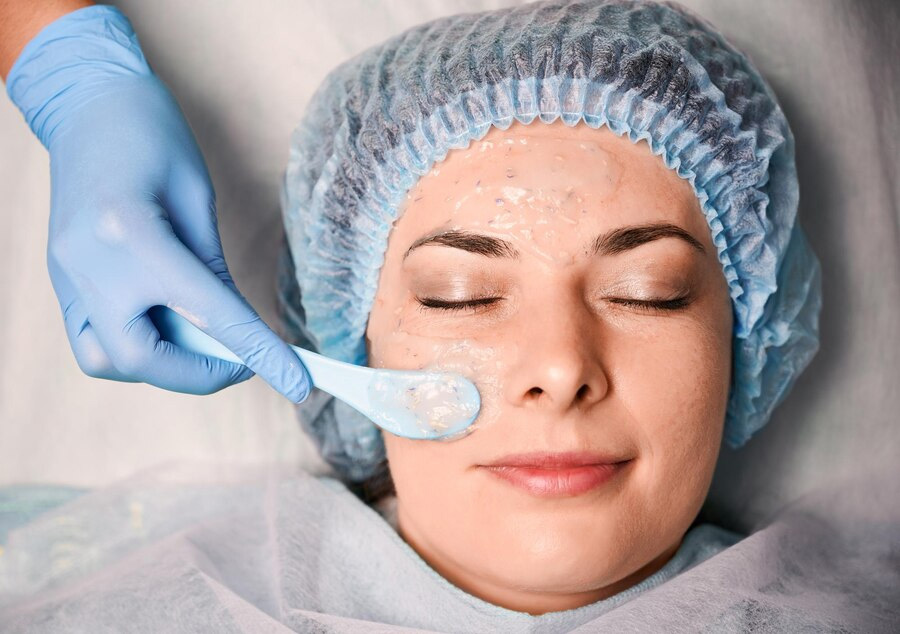
Applied topically, a chemical peel promotes the removal of dead skin cells, stimulates new cells, and encourages the regeneration of collagen. We refer to this as “chemical” exfoliation because it is the peel product itself that sloughs off the outer layers rather than a physical exfoliation. With a series of peels, the skin will begin to show its former luster that has been lost with the effects age, sun damage, and environmental pollutants. Chemical peels are a versatile treatment and provide one of the best cost-to-benefit ratios of all cosmetic services. You can reverse the signs of aging progressively without having to undergo an aggressive treatment. In addition, chemical peels address a multitude of skin issues with minimal downtime.
Peels are classified by their ability to penetrate through tissue:
- Light or superficial peels – only penetrate to the epidermis
- Medium peels – these peels penetrate through the epidermis
- Deep peels – penetrates into the dermis; these are very strong peels with significant downtime
Types of peels
Lactic Acid Peel (Light Peel)
A Lactic acid peel is ideal for first time peelers and sensitive skin types. This AHA (Alpha Hydroxy Acid) peel lightens and brightens while helping the skin retain moisture. This peel can be added to any facial treatment or our HydraFacial MD procedure. Very little to no peeling is expected.
Salicylic Peel (Light Peel)
Salicylic peels are ideal for oily, thick, and acne-prone skin. This peel breaks down oil and exfoliates inside and outside the follicle walls. A series of 3 treatments is recommended for best results, and this salicylic peel can be added to any facial treatment or our HydraFacial MD procedure. Some mild flaking should be expected.
Glycolic Peel (Light Peel)
These peels are ideal for aging skin and those with hyperpigmentation. Glycolic acid penetrates deeper than a lactic acid peel and is ideal for aging skin. This peel can be added to any facial treatment or our HydraFacial MD procedure. A series of 4 to 6 Glycolic treatments is recommended for best results. Very little to no peeling should be expected.
SkinMedica Vitalize Peel (Light to Medium Peel)
The Vitalize peel is ideal for those with pigment abnormalities, acne, and photo damage. The Vitalize treatment is the next step above a Glycolic acid and a Salicylic acid peel and addresses various skin conditions, such as hyperpigmentation, breakouts, and sun damage. This peel renews oily and acneic skin while reducing the look of discoloration but is still safe to use on most skin types. A series of 3 Vitalize peels is recommended for best results. Mild to moderate shedding of the skin is expected with a social downtime of 3-5 days.
TCA Peel (Deep Peel)
The strongest peel we offer at Elite Med Spa is the TCA peel (Trichloroacetic acid). A TCA peel is stronger than the Vitalize peel but still not considered a “deep” peel as it does not go down to the dermis. The TCA peel is also proven to be one of the most effective peels for melasma, sun damage, hyperpigmentation, wrinkles, and acne. It tackles skin problems at the cellular level to erase fine lines and wrinkles, minimize enlarged pores, and build collagen and elastin to tighten and re-texturize skin. There are varying percentages of the TCA acid that can be used. Downtime is about 7 to 10 days after a TCA peel.